Acoustics and Perception
An acoustics research lab for talented middle and high schoolers who play or sing
In-person in Princeton, NJ · or hybrid from anywhere
The Opportunity
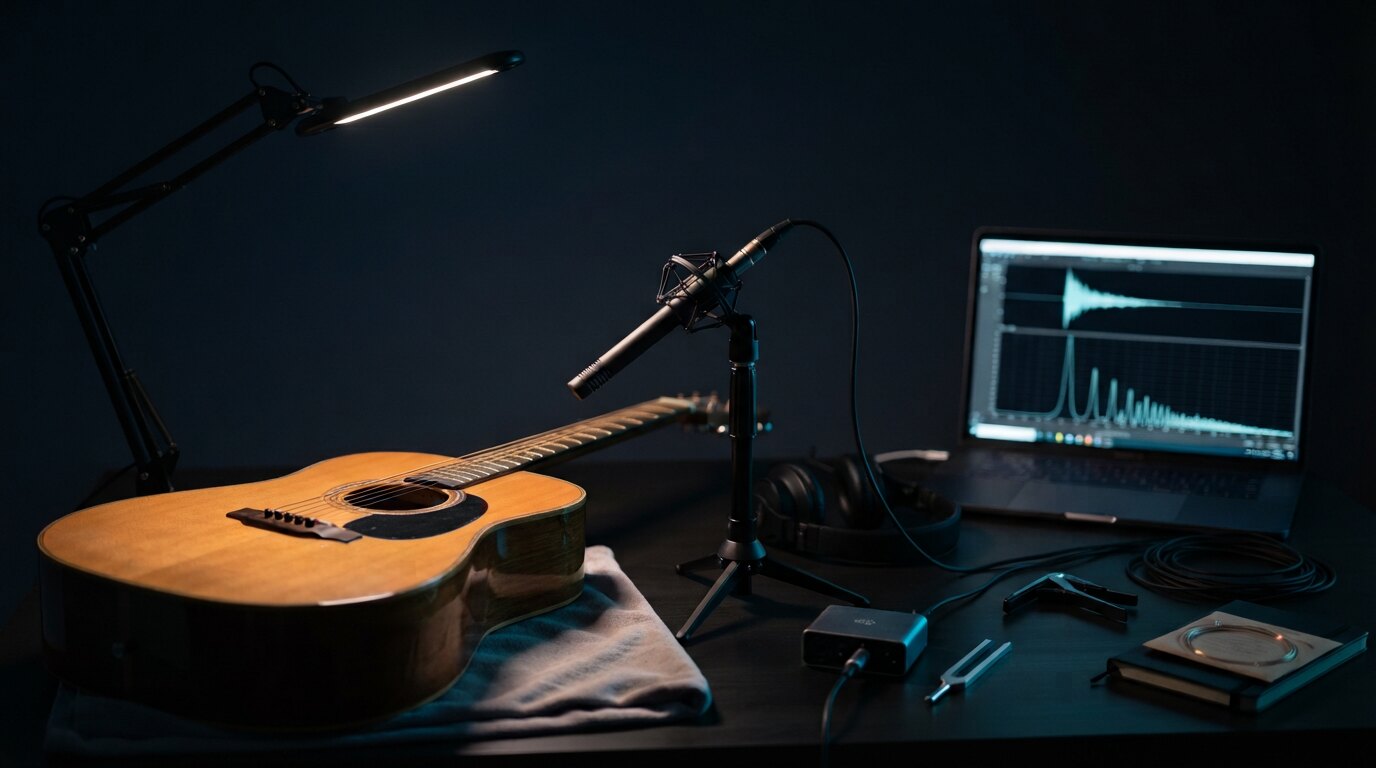
You already make sound: you sing, you drum, you play guitar, maybe you record yourself. This lab turns that trained ear toward science: how instruments and rooms produce and shape sound, and how a listener actually hears it. You can produce the exact sound a question needs, the same note or stroke or phrase. That makes you both experimenter and source.
A large business runs on sound. Recorded music alone brings in more than $30 billion a year (IFPI). Instruments, microphones, and hi-fi gear are a multi-billion-dollar market of their own. Acoustic treatment and soundproofing for rooms, studios, and buildings run to roughly $16 billion a year.
Acoustics and Perception is one of the SoTS Research Labs, which follow the same methodology and format: see Princeton Labs for how semesters work and expectations from students participating in the program.
Recent Work in This Field
This field is active. Recent work covers how instruments and rooms shape sound, how a listener hears it, and what sound does to people who are not listening to it.
Recent publications
Instruments and rooms
- A violin's air resonance tracks the perimeter of its sound holes, not their area (Nia et al., 2015).
- Ten expert drummers asked to play one rock pattern laid-back, on-the-beat and pushed produced systematic differences in intensity and timbre (Danielsen, 2015).
How sound is heard
- Harpists carry an acoustical signature a listener can distinguish even on isolated notes (Chadefaux & Le Carrou, 2012).
- Spectral-centroid similarity and onset synchrony predict whether instruments fuse into one perceived voice (McAdams, 2018).
- In double-blind tests, expert soloists could not tell six Old Italian violins from six new ones at better than chance, and a new violin was the most preferred (Fritz et al., 2014).
Sound and the people around it
- WHO's European guidelines recommend exposure levels for transport, wind turbine and leisure noise, drawn from the evidence on health impacts (WHO, 2018).
- Across 74 studies, the odds of being highly sleep disturbed rose with every 10 dB of night-time transport noise (Basner & McGuire, 2018).
Prerequisites
Open to high school, middle school, and home school students who play or sing seriously. No prior research experience is required.
Full requirements
- Youth orchestra, band, jazz, choir, drumline, a group with friends, and recording at home all count
- Curious about why and how your sound is what it is, not just how to make it
- Willing to read into a real literature and design your own study, not follow pre-made assignments
- Commitment to weekly meetings and work between sessions
A year of physics is useful preparation but not required.
Schedule, Tuition, and Enrollment
Pass the SoTS membership fit evaluation and be accepted as a member before requesting to join a Research Lab. Lab prerequisites and available places also apply.
Schedule, tuition, and enrollment