SoTS Physics Lyceum: Princeton

Multi-year physics curriculum for students in homeschools, public schools, and private schools. Middle school and high school programs, online and in person.

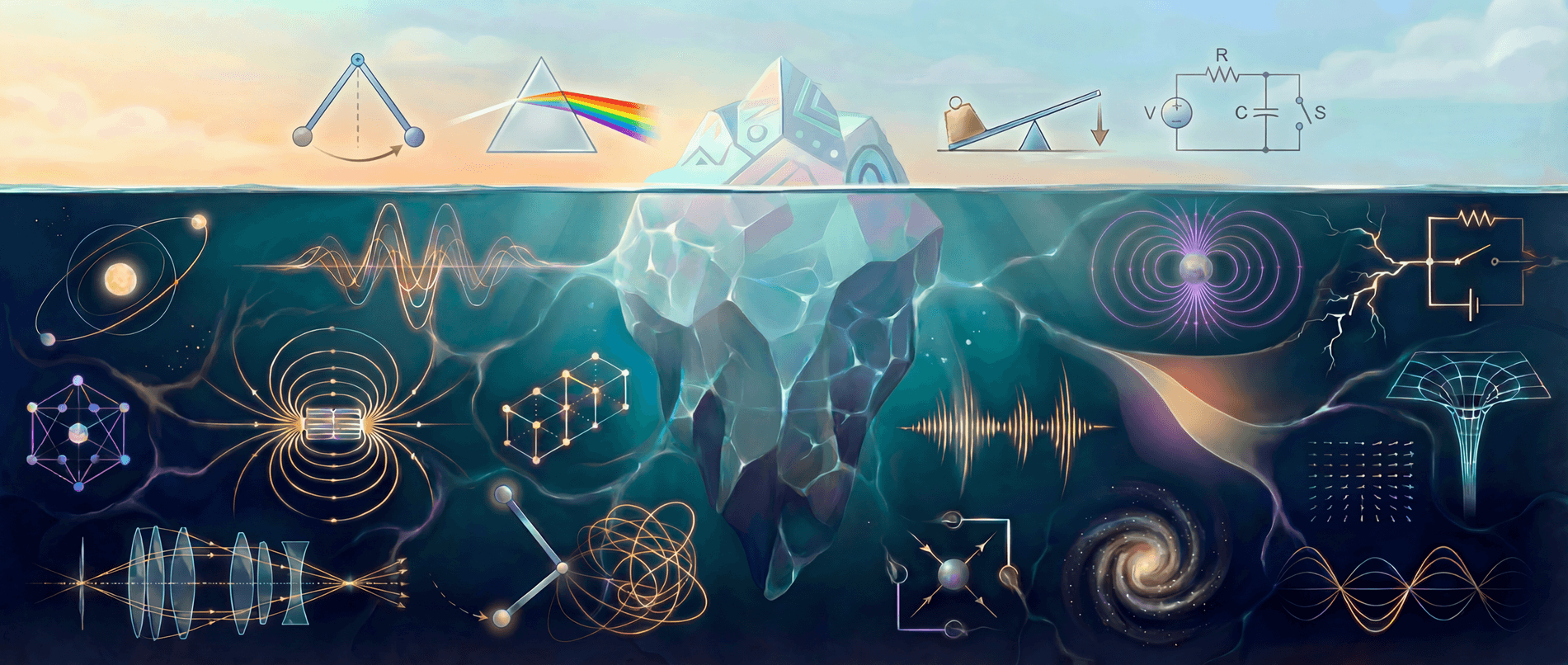
SoTS Physics Lyceum: iceberg metaphor showing the depth of understanding built across mechanics, waves, electromagnetism, optics, and modern physics

The Place Where Physics Is Taught by Expert Physicists

Physics is one of the most elegant and beautiful ways to understand the reality around us. We built the Lyceum so students can encounter the subject the way it deserves to be encountered, not as something to get through, but as something worth loving back.

That shapes how we teach. Physics is best learned by reasoning from physical principles, not by memorizing formulas. Our students learn to derive results rather than retrieve them, to build intuition rather than recognize patterns, to work through a problem they have never seen because they understand the physics, not because they have matched it to a template. This is the Deep Physics methodology, the approach we use across every Lyceum course.

Our curriculum is shaped by what physics requires, not by what any third-party exam happens to measure. We do not optimize for AP exams.

And it shapes how we grade. During the course, homework and classwork are graded honestly: no inflation, no curving, every score reflects what the student understood. A certificate adds the instructor’s expert judgment: a Pass/Fail decision made in an in-person evaluation, drawing on both the student’s coursework and what they show in the room. A student who has learned thermodynamics deserves to be told so, and one who hasn’t shouldn’t be told otherwise.

The Lyceum programs are taught by expert physicists. In our classrooms and seminars, students discuss and work through problems alongside an expert physicist: deriving results from first principles, weighing approaches together, and examining the assumptions behind every step.

What This Builds

Lyceum students leave with physics intuition they actually own. Not a list of memorized formulas, but the ability to reason from first principles about systems they have never seen.

That foundation transfers:

  • University physics at majors level. Students walk into freshman mechanics or quantum already at home with the conceptual structure, free to focus on the calculus rather than playing catch-up.
  • Research lab work. The reasoning patterns of physics (derive, check limits, examine assumptions) are the reasoning patterns of every quantitative research field.
  • Any field that requires thinking about reality. Engineering, computer science, biology, finance, machine learning. None of them reward pattern recognition the way they reward principled understanding.

For where this leads (the fields physics graduates enter, why a physics degree is one of the strongest undergraduate paths), see The Hidden Ivy League.

The Lyceum is not designed to win on the AP exam. It is designed to build something that lasts, during the years when deep conceptual understanding actually takes root.

Programs

We teach physics to teenagers with depth and breadth, over time.

The Lyceum is a multi-year physics curriculum. We run separate programs for middle schoolers and for high schoolers, with material appropriate for each age. Both are offered online and in-person in Princeton. Alongside the curriculum, the Physics Tournament Lab offers open-ended research, in-person or hybrid.

Middle school (grades 7–8): material appropriate for middle school, delivered as single-topic two-month modules (Mechanics, Thermodynamics, Electricity & Magnetism, Optics) year-round, plus four single-topic summer camps (Mechanics, Thermodynamics, E&M, Optics). Middle schoolers who complete the program arrive at the high school Lyceum already grounded in classical physics.

High school (grades 9–12): six classical core courses (two semesters of mechanics, then waves and oscillations, thermodynamics, electricity and magnetism, and geometric optics) plus four Modern Physics electives (special relativity, quantum mechanics, nuclear and particle physics, astronomy and cosmology). Each course runs one semester (twice-weekly theory plus seminar), year-round across fall, spring, and summer. Largely independent: a student can take a single course or build a full sequence.

Physics Tournament Lab: alongside the curriculum, open-ended research on IYPT-style problems for grades 7–12 (advanced). In-person in Princeton, or hybrid (weekly Zoom plus a few half-day visits per semester) for students anywhere. High school students can pursue IYPT competition selection. Enrollment via Princeton Labs.

The Physics Path

From a 7th grader’s first real physics to original research. A student can enter at any stage.

Foundation · grades 7–12Physics Courses
Middle Schoolfour classical topicsHigh School · classicalsix core coursesHigh School · modernfour electives
do research in parallel
CompetePhysics Tournament

Open-ended IYPT-style problems. Build apparatus, develop theory, run simulations, defend conclusions. Take them to competition or pursue them as research.

ResearchSoTS Research Labs

Your own project, grounded in physics. Science of Seeing (optics) and Sound and Human (acoustics) build on it directly. Planet Impact, Games, and AI use the same way of thinking.

Join & leadClub Network

Local research communities. Join one to work together, or start and lead a club of your own. The Research Leadership Program trains students to build and guide a research group of their own.

go further, for experienced researchers
Go further

Research Residency applies it in a small team, R&D style, on open problems commissioned by academic, government, and industry partners.

Who Leads the Lyceum

Dr. Sergey Samsonau leads the Lyceum: PhD in physics, with twenty-five years in physics at depth, including fifteen years teaching in the United States at NYU, CUNY, and PRISMS.

His training covers the full breadth of how modern physics is done:

  • Theory. Trained in the physics-mathematics school tradition (MS, theoretical physics).
  • Experiment. PhD research in nanotechnology: vacuum systems, thin-film growth of carbon nanofilms, atomic force microscopy, clean-room nanofabrication.
  • Simulation and modeling. Numerical work on high-performance clusters: density functional theory in Quantum Espresso, analytical modeling in Mathematica.
  • AI for science. Founded AI for Scientific Research at NYU, architected NYU’s private GenAI ecosystem, leads development of the SoTS AI Research Mentor.
  • Educational innovation. Multiple innovations at high school and university level, with peer-reviewed methodologies on physics teaching, authentic research, and AI-era research education (Physics Education IOP, IEEE, arXiv).

The Lyceum also benefits from the SoTS strategic advisors:

  • Matthew Pearce. 30+ years advancing research-based education at world-leading high schools (Latymer Upper London, TJHSST, PRISMS). Pioneer in turning authentic inquiry into disciplined, modern methodology.
  • Dr. Luke Perkins. UC Berkeley PhD in Nuclear Engineering (graduate research at LBNL). 30+ years in industrial R&D including Schlumberger and PPPL. 21 patents, 100+ invention disclosures.

See Dr. Samsonau’s full profile and the SoTS team page for more details.

What Completing the Lyceum Means

A student who follows the curriculum from middle school through the classical core and on into the modern electives will reason from first principles, have intuition for how nature works, and arrive at university physics well prepared, ready to thrive in introductory courses and continue further if they choose.

  • They reason from first principles. Not from a memorized template.
  • They have intuition about how nature works. They can predict what should happen before they pick up a formula.
  • They can work through problems they have never seen, because they understand the physics, not just the formulas.

Students build the lasting intuition that forms a sound foundation for scientific thinking in any career. Physics is a required subject for medicine, pharmacy, engineering, physical therapy, chemistry, physics, and scientific careers.

More fundamentally: they will have learned what it means to understand a subject deeply. That carries into whatever they study next.

Certificates and Transcripts

The Lyceum issues Pass/Fail certificates earned through course evaluations and through research work, a cumulative transcript when more than one is earned, and named program credentials for students who complete the full Lyceum scope:

  • Lyceum Course Certificate: per Lyceum course passed.
  • Certificate of Research Training: per semester of the Physics Tournament Lab completed in good standing.
  • Cumulative Transcript: a running record of coursework, research, and any certificates earned. Available to every Lyceum student.
  • Lyceum Certificates of Mastery: full program credentials in Classical Physics, in Classical and Modern Physics, and the same with Research.

See Physics Certificates and Transcripts for the full credential structure, requirements, and grading philosophy.

Who This Is For

Students grades 7 through 12 who want to learn physics seriously, and families who recognize that serious physics learning takes time and depth. The Lyceum serves students in public schools, private schools, and homeschools across both programs: the middle school program for grades 7–8 and the high school program for grades 9–12. Either program can be taken online or in person.

The Lyceum is part of the Society of Teen Scientists, a Princeton-based community for young scientists.