Optics and Perception
An optics and perception research lab for talented middle and high schoolers who make images
In-person in Princeton, NJ · or hybrid from anywhere
The Opportunity
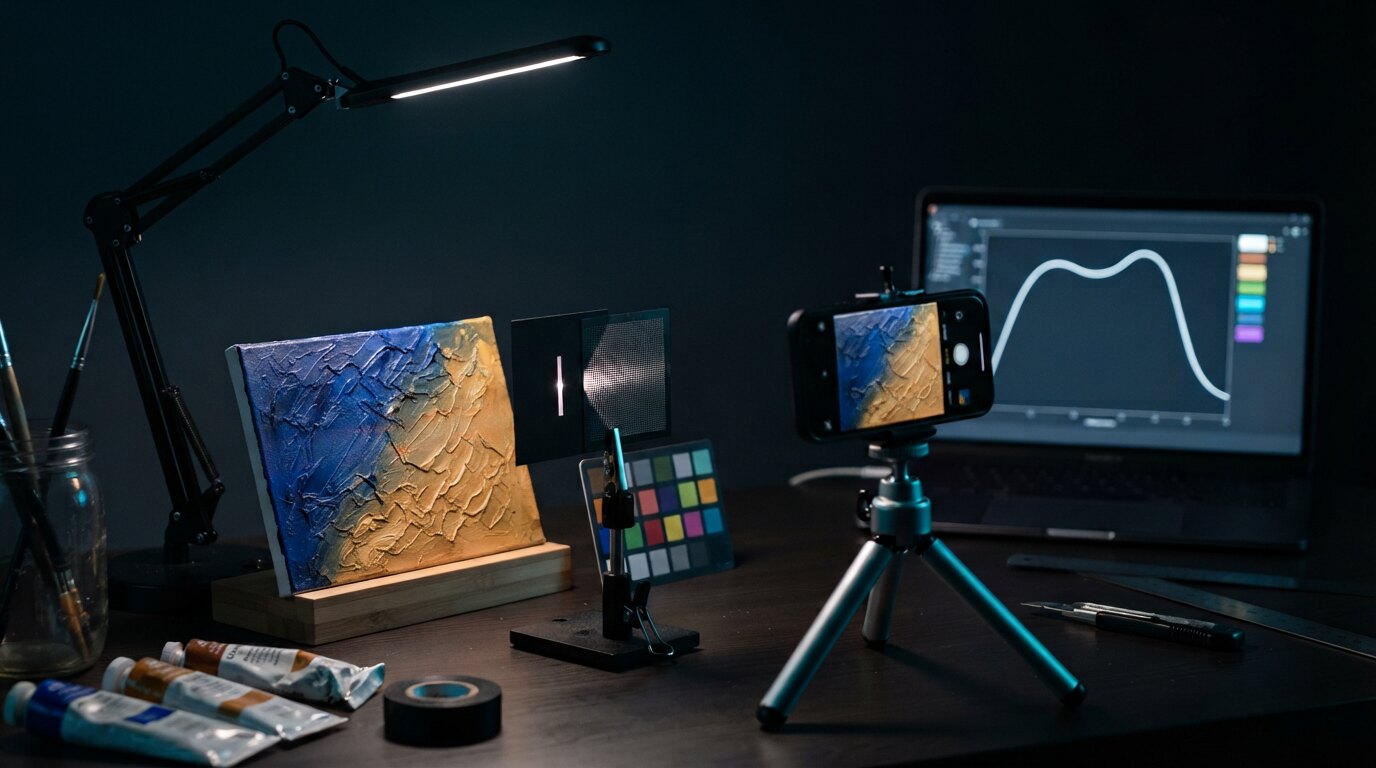
You already make images: paintings, photos, designs. This lab turns that trained eye toward science: how lenses form images, how pigments reflect spectra, and why a painting differs from its photograph. You can create exactly what a question demands: precise swatches, controlled compositions, specific lighting. That makes you both experimenter and source.
A vast economy depends on appearance. The global art market moves tens of billions annually. Far larger industries like coatings, cosmetics, cameras, print, and film all hinge on light and color.
Optics and Perception is one of the SoTS Research Labs, which follow the same methodology and format: see Princeton Labs for how semesters work and expectations from students participating in the program.
Recent Work in This Field
This is an active field. Recent research spans optical instruments, light and color measurement, visual perception, and the differences between originals and copies.
Recent publications
Optics and instruments
- A $1 paper microscope with a glass bead resolves near a micron (Cybulski et al., 2014).
- A cured silicone droplet turns a phone into a microscope lens for under a cent (Lee et al., 2014).
- A $30 open-source spectrophotometer uses a phone camera to match lab instruments for water quality testing (Feng et al., 2021).
- A $150 Raspberry Pi microscope merges hundreds of low-res photos into one ultra-sharp image (Aidukas et al., 2019).
Light, color, and surface
- A neural network, never taught gloss, still reproduces both correct gloss perception and common mistakes (Storrs et al., 2021).
- Butterfly wing color shifts come from ordinary scale ridges, not finer nanostructures (Zobl et al., 2020).
- A calibrated phone camera identified historical pigments in painting replicas (Sáez-Hernández et al., 2024).
How the eye reads an image
- "The dress" split viewers into white-gold and blue-black camps due to different lighting assumptions (Lafer-Sousa et al., 2015). Images that split viewers this way share a recipe: two washed-out, complementary colors (Jeong, 2021).
- Color constancy fails most for highly saturated surfaces (Foster & Reeves, 2022).
- People were more sensitive to color differences at many color name boundaries, and a model simulation suggests that effect strengthens as the difference grows (Li & Nagai, 2024).
- People spot physically impossible shadows only ~60% of the time and near-chance on reflections until errors are large (Nightingale et al., 2019).
The original and its copy
- Museum visitors look longer at and rate real artworks higher than digital images (Brieber et al., 2014).
- The larger the painting, the farther back viewers stand, following a tight linear relationship (Carbon, 2017).
- Asked hypothetically, people prefer physical prints over live indirect views, and mirrors over equivalent monitors (Bertamini & Blakemore, 2019).
Prerequisites
Open to high school, middle school, and home school students who make or study visual art seriously. No prior research experience is required.
Full requirements
- Painting, drawing, photography, digital art, design, printmaking, animation, and film all count
- Curious about why and how an image looks the way it does, not just how to make it
- Willing to read into a real literature and design your own study, not follow pre-made assignments
- Commitment to weekly meetings and work between sessions
A year of physics is useful preparation but not required.
Schedule, Tuition, and Enrollment
Pass the SoTS membership fit evaluation and be accepted as a member before requesting to join a Research Lab. Lab prerequisites and available places also apply.
Schedule, tuition, and enrollment