Deep Physics
Advanced physics training tailored for talented high schoolers
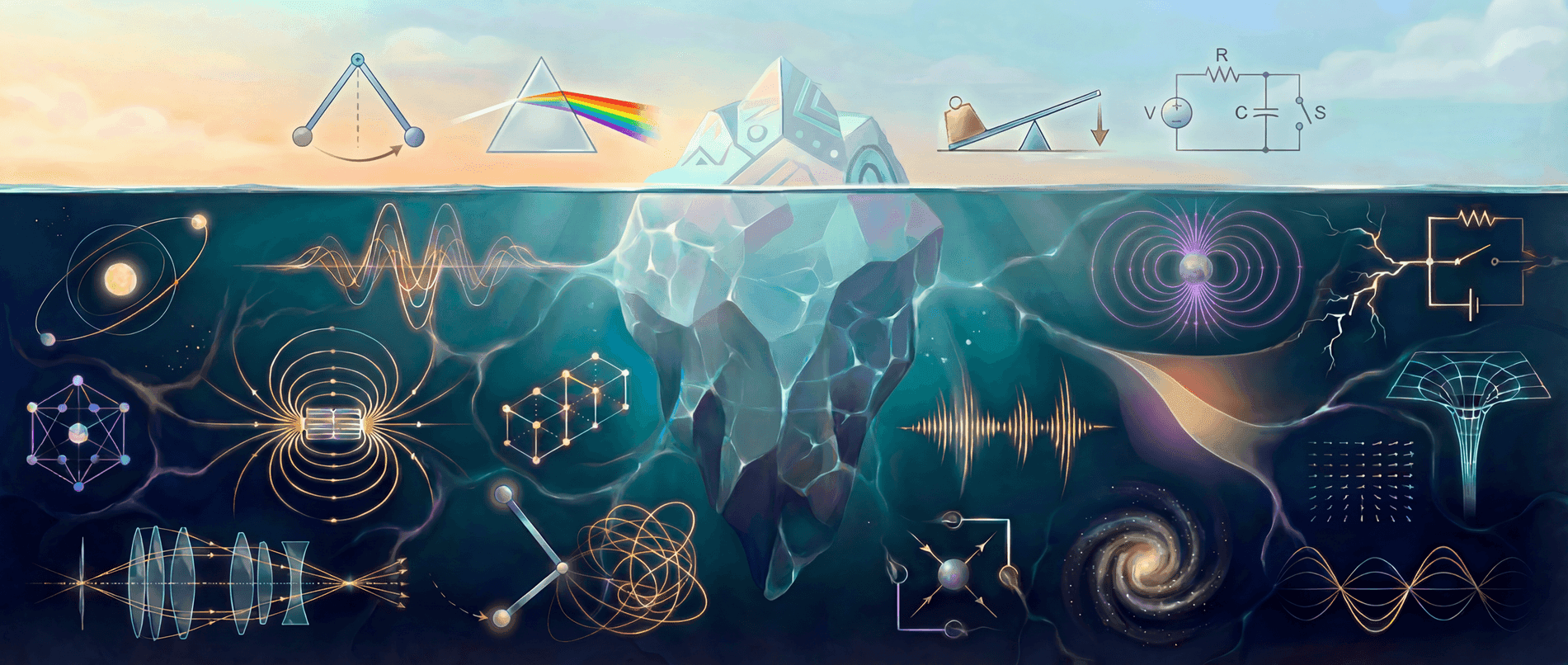
What Is Deep Physics
Deep Physics is a year-round physics program tailored for talented students, built on three components: theory, problem-solving, and research. Theory is taught through Core Theory and Practice intensive one-week programs (spring and summer). Problem-solving is practiced in weekly sessions throughout the year. Research happens through open-ended physics problems in our Physics Tournament Lab. All three reinforce each other. Students can start with any component.
How Deep Physics Is Different from Honors and AP Physics
Talent development exists in every field. In sports, talented young athletes are identified, get specialized coaching, and train differently. Instead of standard skill drilling oriented on winning the next game, a different training is given to the most talented group, developing the athlete at the core.
Just as different types of athletic training work best for specific athletes, Deep Physics works for students whose aptitude fits this methodology. The training can overwhelm students who aren't ready for it. It works beautifully, though, for students who think this way: something clicks creating interest, excitement, deep engagement.
Two Paths in Physics: The General Path
Classes like Honors Physics and Accelerated Physics in the USA, and similar general track physics classes in other countries, typically follow a pattern recognition approach:
Here is the formula. Memorize it. Practice to recognize patterns of when to use it. Next formula.
AP Physics adds mathematics of university level. But the underlying method does not change.
Two Paths in Physics: Deep Physics
Deep Physics at SoTS follows the physics-mathematics school tradition — a methodology with deep historical roots, systematized in the 1960s specifically for students with special talents in physics and refined over decades since. Students trained in this tradition have gone on to become Nobel and Fields Medal winners, scientists, and engineers working at the forefront of their fields.
Consider Snell's law, which describes light refraction.
The general path would present it as a formula to memorize: n₁ sin θ₁ = n₂ sin θ₂. For a student to learn when to apply, and move on.
Deep Physics, on the other hand, explores: what happens when a wavefront of light hits an interface between two media? We work through wavefront propagation. We see that different parts of the wavefront travel at different speeds in different media. The bending emerges from this physical reality. The formula is not given; it is derived.
The student who derives Snell's law owns it. If they forget the formula years later, they can reconstruct it. More importantly, they understand what refraction actually is.
What This Creates
Physics intuition that transfers beyond memorized patterns:
To unfamiliar physics situations not covered in any textbook. To engineering problems where multiple principles interact. To other STEM fields. To any situation requiring thinking from first principles rather than retrieving a template.
This intuition will serve both in college and STEM-related career after that.
This is how real scientists are forged
Programs
Theory · Practice · International Tournament (IYPT)
Core Theory and Practice: Spring
One week of full immersion in mechanics. Kinematics, dynamics, conservation laws, rotational motion, statics, hydrostatics.
Details & Sign Up →Core Theory and Practice: Summer
Three independent weeks: thermodynamics, electricity & magnetism, optics. Choose one, two, or all three.
Details & Sign Up →Deep Physics: Weekly
Core Theory and Practice twice weekly + Advanced problem solving once weekly. 10-week modules: mechanics, thermodynamics, electricity & magnetism, optics. Princeton, NJ and Fair Lawn, NJ.
Details & Sign Up →Physics Tournament Lab
Open-ended research projects modeled on the International Young Physicists' Tournament (IYPT). Students can participate in selection for the international tournament. Real physics problems with no definitive known answers.
Details →What You Develop
You build the lasting intuition that forms a sound foundation for scientific thinking for any career. Physics is a required subject for medicine, pharmacy, engineering, physical therapy, chemistry, physics, and scientific careers.
- Intuitive problem setup for unfamiliar situations
- Conceptual connections across physics topics
- Lasting foundations that make college physics manageable
- Deep thinking skills that transfer to other technical subjects
Side effects: school physics becomes easier, AP Physics is no longer intimidating, improved readiness for competitions if that interests you.