AI Meets Physics
An AI research lab for talented middle and high schoolers who want to find out what a machine really knows about the physical world
In-person in Princeton, NJ · or hybrid from anywhere
The Opportunity
The best AI models now win gold medals at physics olympiads and are promised to do graduate-level intellectual work. But show one a ball rolling behind a screen and ask if it is still there, and most do no better than a coin flip. People score near-perfect on that, and infants figure it out early. That is the gap between AI success on tests and real-world tasks.
Researchers are trying different kinds of AI. Most learn from text and pictures, reading descriptions of the world and predicting what comes next. Others skip the descriptions and train on video and movement, since a machine that has to act in the world, a robot reaching for something, must anticipate what happens next.
Where the physics is already known, machines do real work: they have designed gravitational wave detectors, controlled plasma inside a tokamak, and now forecast the weather.
Yet we test their true understanding almost entirely through exams, where the answer is written down before the question is asked. This lab measures them against real physical systems with no answer key: a unit that does not balance, a limit that comes out wrong, energy that does not add up.
AI Meets Physics is one of the SoTS Research Labs, which follow the same methodology and format: see Princeton Labs for how semesters work and expectations from students participating in the program.
Recent Work in This Field
This field moves fast. Recent work tests AI on olympiad physics, on the everyday physics that small children already understand, on rules the models have never seen before, and on the physics that machines are already trusted with.
Recent publications
Exam physics
- On 13 olympiad exams, the best closed-source reasoning models won 6 to 12 gold medals, while open-source multimodal models mostly stayed at bronze or below (Yu et al., 2025).
- On 500 original problems from high school to olympiad level, the best AI scored 36.9% against a human expert baseline of 61.9% (Qiu et al., 2025).
Physics a child already knows
- Most AI models performed at chance on the basic physics that infants learn early: object permanence, immutability, spatio-temporal continuity, and solidity. Humans got nearly every answer right (Bordes et al., 2025).
- Across 396 filmed events in solid mechanics, fluids, optics, thermodynamics and magnetism, the best video generation model scored only 29.5%. Its physical understanding had no connection to how realistic its videos looked (Motamed et al., 2025).
- After training on a million hours of video, then seeing under 62 hours of robot video, one model could plan pick-and-place tasks on robotic arms it had never seen before (Assran et al., 2025).
Physics the AI has never seen
- Test scores cannot separate true reasoning from memorization, so one study placed models inside invented physics worlds: F = mv, Aristotelian mechanics, a four-domain Decay World. Across three leading models, the three worlds yielded composite pass rates of 6, 6 and 0 out of 15 (Zhang, 2026).
- One model trained on orbital trajectories predicted them accurately. But when researchers checked how it worked, it had not learned Newtonian force vectors. Instead, it developed task-specific shortcuts (Vafa et al., 2025).
- A generated simulation can run, mesh, and converge while using the wrong equations. Standard execution-based checks cannot tell the difference from a correct run (Song et al., 2026).
Where AI already works
- A machine-learned model has forecast the weather operationally at the European Centre for Medium-Range Weather Forecasts since February 2025, in a field where such models now rival or outperform the physics-based ones (Moldovan et al., 2025).
- Urania designed gravitational wave detector layouts that outperform current designs. One layout improved average sensitivity by a factor of 4.1. The 50 best designs were published as a public detector collection (Krenn et al., 2025).
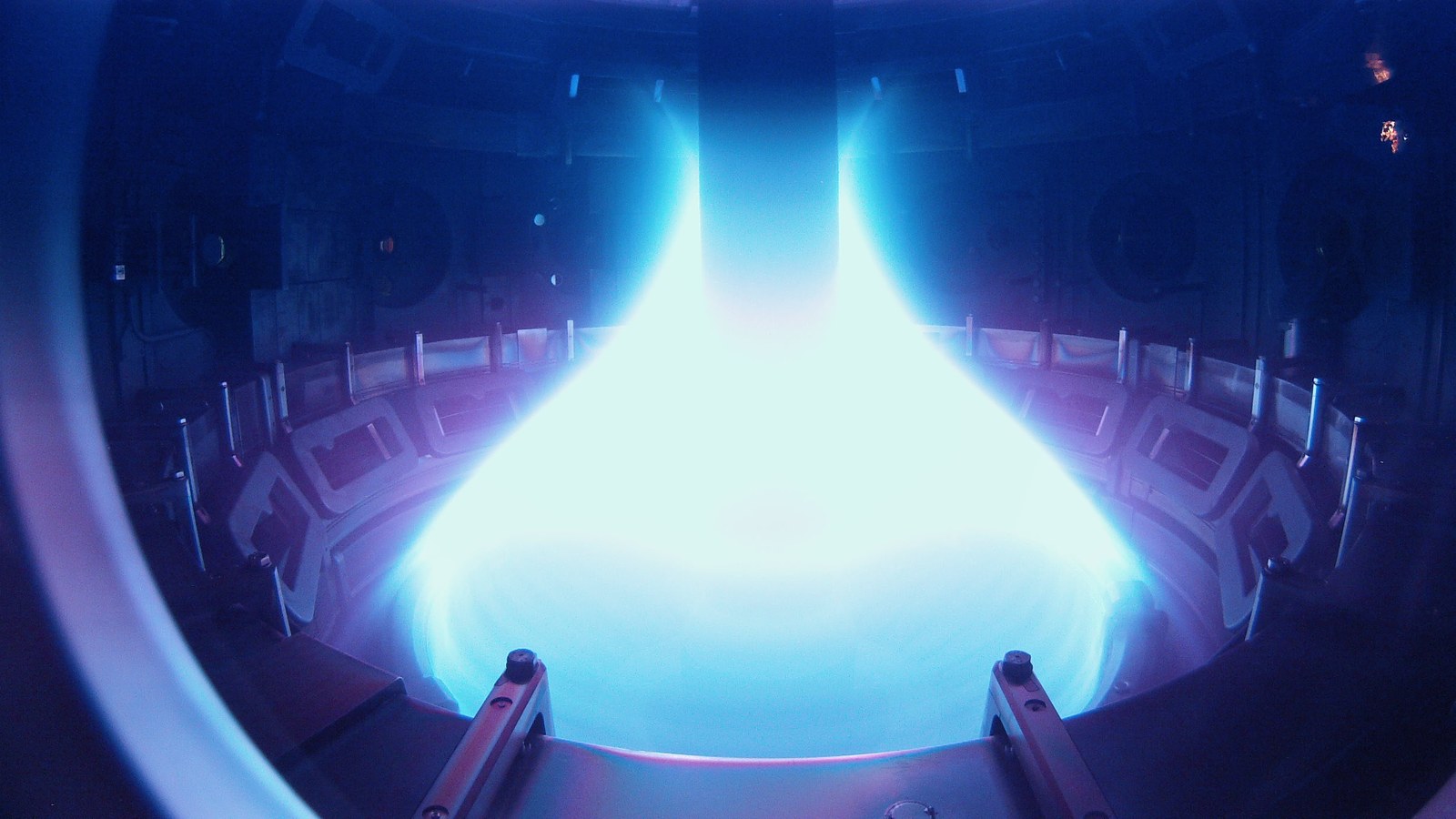
- A controller trained with reinforcement learning shaped and held plasma in the TCV tokamak, controlling 19 magnetic coils at 10 kHz (Degrave et al., 2022).
- Machine learning found the first new gravitational wave candidate events in data from a network of interferometric detectors (Koloniari et al., 2024).
Prerequisites
Open to high school, middle school, and home school students with a year of physics or currently taking it. No prior AI or research experience is required.
Full requirements
- Ready to read real research papers and design your own study, not just follow pre-made assignments
- Commitment to weekly meetings and work between sessions
- Basic statistics and a version control tool (like Git) are helpful but not required
Schedule, Tuition, and Enrollment
Pass the SoTS membership fit evaluation and be accepted as a member before requesting to join a Research Lab. Lab prerequisites and available places also apply.
Schedule, tuition, and enrollmentImage on top of page: plasma inside the Mega Ampere Spherical Tokamak at Culham, Oxfordshire. Eye Steel Film (CC BY 2.0), cropped