Environmental Physics
An environmental research lab for talented middle and high schoolers who study Earth systems
In-person in Princeton, NJ · or hybrid from anywhere
The Opportunity
Are you ready to use physics to understand the environment we live in and care about?
- How fast a snowpack melts depends on what darkens its surface, the slope it lies on and which way it faces, and the sun it gets. Separating these factors is difficult, and researchers are still developing methods.
- How a lake holds its heat depends on its water exchange: what flows in, how long it stays, how the layers mix. The dates ice arrives and leaves now swing widely year to year, and conditions beneath it are poorly constrained.
- How much carbon and water a forest trades with the air depends on heat, drought, and the age of the stand. Growth is slowing in northern Europe, and the cause is unknown.
- How fast an algal bloom takes a lake over depends on nutrients, warmth, and how long the water sits stratified. Predicting which will bloom, and when, is difficult, and the models are moving to machine learning.
- How much heat reaches Europe depends on ocean and air currents together, which is why it is milder than its latitude. The Atlantic overturning circulation that carries it is expected to weaken, and what that does to European rainfall and temperature is unsettled.
These are just examples; there are even more exciting areas to explore.
Environmental Physics is one of the SoTS Research Labs, which follow the same methodology and format: see Princeton Labs for how semesters work and expectations from students participating in the program.
Recent Work in This Field
This field is active, and its literature is quantitative.
Recent work covers what darkens snow and how much faster it then melts, the timing of lake ice and the mixing it governs, the circulation of ocean and air and what a forest exchanges with it, and what the public biodiversity archives can and cannot support.
Recent publications
Snow, and what darkens it
- A deep-learning emulator of a radiative transfer model, inverted against 180 field spectra, separated the darkening effects of mineral dust, black carbon and red algae (Chevrollier et al., 2025).
- Tuning a snowpack model's darkening coefficient to a global climatology of particle deposition cut albedo error by 10 percent on average, and by 25 percent at the Arctic sites (Gaillard et al., 2025).
- Adding light-absorbing impurities to a snowpack model's mass and energy balance put the snow days lost to dust and soot at between 5 and 24, depending on site (Zorzetto et al., 2025).
Lake ice, stratification, and mixing
- Ice-on and ice-off dates for 78 lakes in 12 countries were compiled into one record, some series running 578 years, among the longest climate observations people have collected (Sharma et al., 2022).
- In a 92-year record from a single dimictic lake, spring air temperature and cumulative February-to-April snowfall together explained over 80 percent of the variation in ice-off timing (Oleksy & Richardson, 2024).
- Lake surface warming in the ice-off month runs about 1.4 times the open-water rate, which the authors attribute predominantly to an eight-day advance in ice break-up between 1979 and 2020 (Li et al., 2022).
- A lake-climate model ensemble put stratification beginning 22 days earlier and ending 11 days later by 2099 under high emissions, a prolongation of roughly 33 days (Woolway et al., 2021).
Exchange and circulation
- Seven boreal coniferous flux towers found a carbon and water response only at extreme soil dryness; at two sites annual net ecosystem productivity fell 20 to 40 percent in a drought year (Peltola et al., 2026).
- Ocean temperature and heat content were gridded into one open dataset, so measurements from different instruments and eras compare on a single grid (Cheng et al., 2024).
- Machine learning trained on a high-resolution ocean simulation reconstructed the geostrophic part of the Atlantic overturning circulation from Argo profiles, to 80 percent explained variance (Wölker et al., 2025).
What the archives can support
- Comparing participatory platforms against academic records for Iberian insects found taxonomic bias in both, with citizen science data giving broader spatial coverage and clearer seasonal trends (Díaz-Calafat et al., 2024).
- Removing duplicate coordinates from GBIF pollinator records cut the bee dataset by 81 percent, and 80 percent of the bee and butterfly records that remained postdate 2022 (Rahimi & Jung, 2025).
Where the Measurements Come From
A question here is answered from measurements you make, from measurements already made by someone else, or from both. Neither is the lesser route.
Each checks the other: a reading you take can be set against thirty years from that watershed, and an archive pattern against a measurement of your own. Either way the work is quantitative: models written as equations, numerical simulation, statistics on long records, and machine learning where the data is large enough to need it.
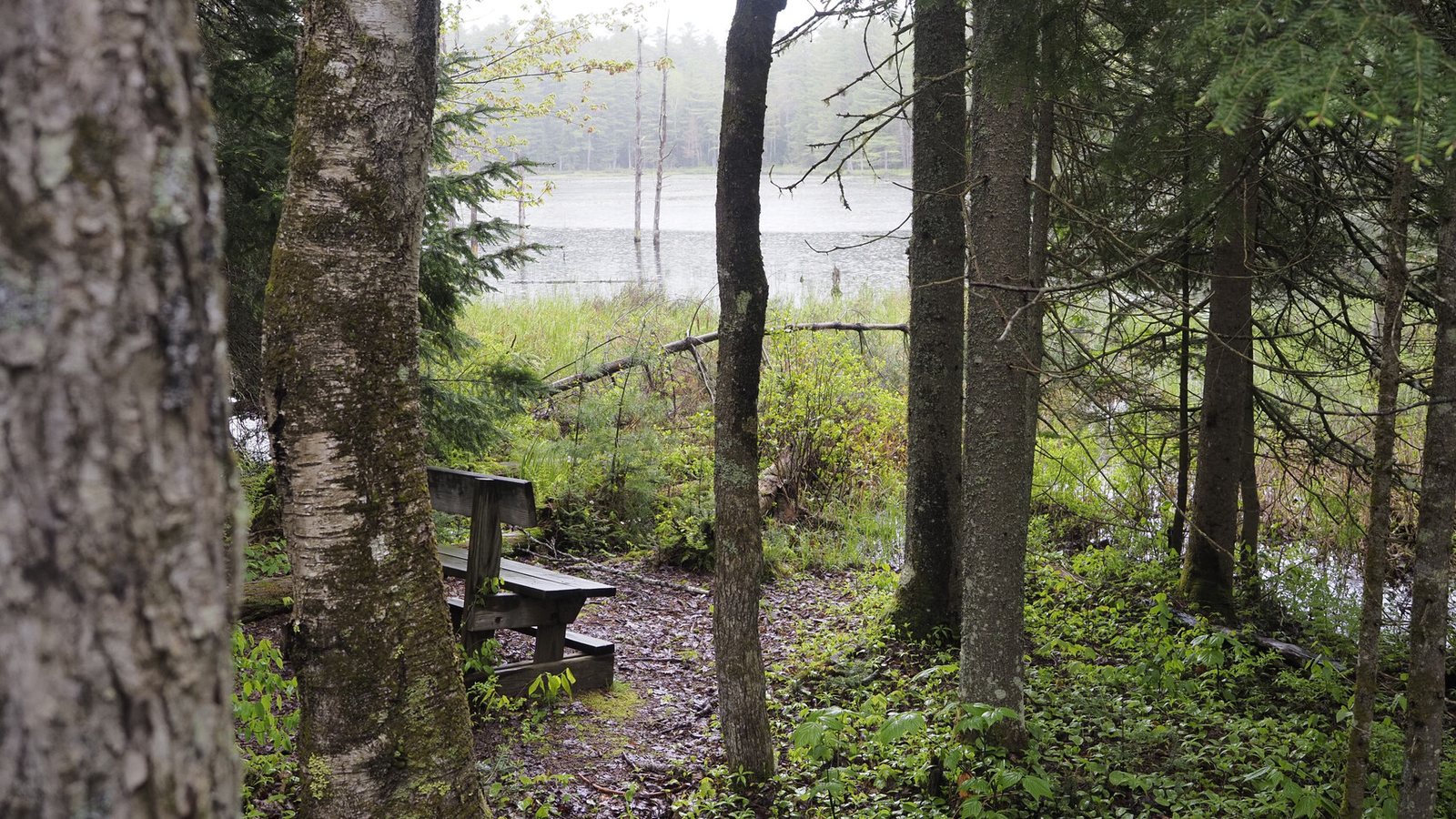
For measurements of your own you need a consistent location you can return to. Public land is often that place, and often keeps a record too: the National Park Service has monitored hundreds of sites since 1998.
Students attending in person also work two conservation sites near Princeton: the Watershed Institute and Duke Farms.
For measurements already made, the record is public, and runs from national networks down to single watersheds. Finding the source that fits a question is part of the work, so these are examples rather than a complete list:
- Snow and ice: SNOTEL, CODOS
- Water and coast: USGS Water Data for the Nation, Water Quality Portal, NOAA Tides and Currents
- Forests and whole ecosystems: Forest Inventory and Analysis, AmeriFlux, NEON
- Air and climate: EPA AirData, NOAA NCEI
- Living things: GBIF, iNaturalist
- Local and state: NPS Inventory & Monitoring, StreamWatch, Duke Farms
Prerequisites
Open to high school, middle school, and home school students who want to study Earth systems. Neither prior research experience nor physics is required.
Full requirements
- Drawn to snow, water, forests, air, and living things, whether through hiking, camping, paddling, or revisiting a favorite patch of woods
- Ready to engage with scientific literature and design your own research project
- Comfortable with data analysis, modeling, or simulation on a computer
- Able to commit to weekly meetings and independent work between sessions
Schedule, Tuition, and Enrollment
Pass the SoTS membership fit evaluation and be accepted as a member before requesting to join a Research Lab. Lab prerequisites and available places also apply.
Schedule, tuition, and enrollment