Physics of Everyday Phenomena
A physics research lab for talented middle and high schoolers who want to go beyond ordinary
In-person in Princeton, NJ · or hybrid from anywhere
The Opportunity
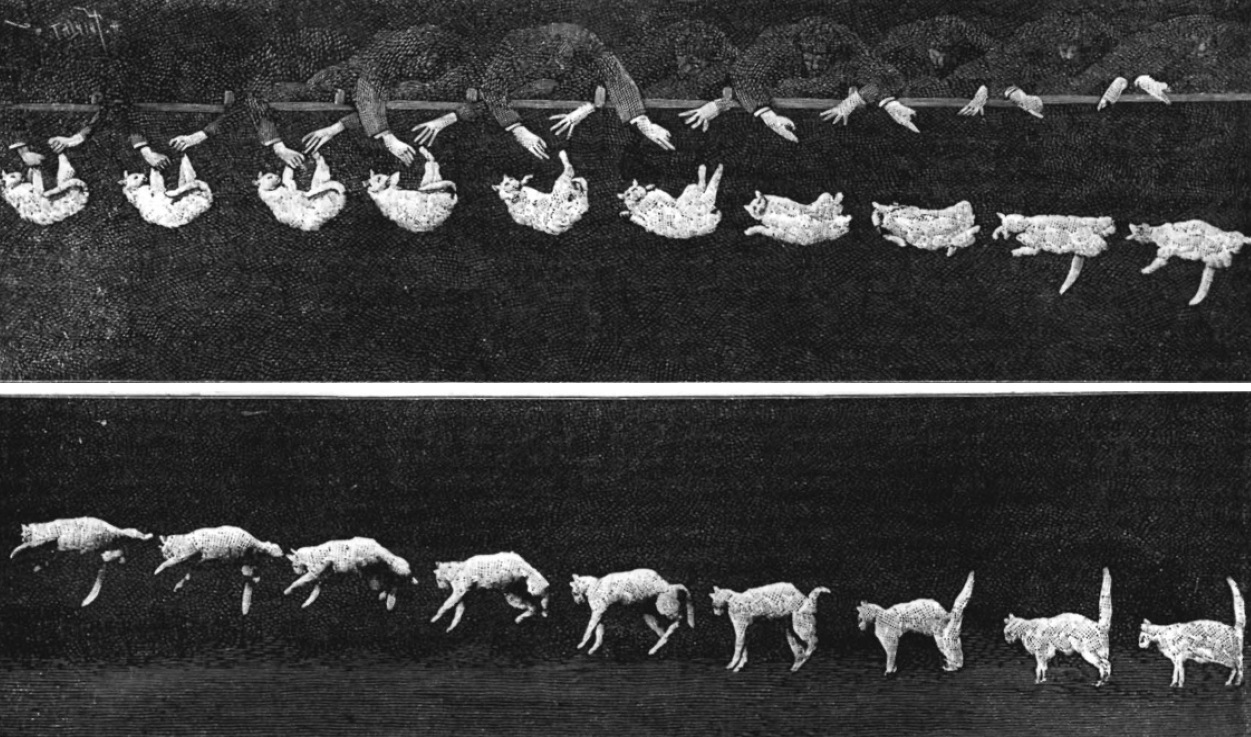
This lab studies the physics hidden in ordinary objects and familiar experiences. The questions are simple to state but rich to investigate, for example how a falling drop deforms, what keeps a moving bicycle upright, how cats reorient in midair, why the vanes of a radiometer spin in sunlight, or what shapes a rainbow. Common phenomena are surprisingly rich in physics if you look deep enough.
Physicists keep studying such phenomena, building on what we know to explore what we don't. We have precise data on raindrops from 1949, yet how they behave in turbulent conditions is still active research. The falling cat problem has intrigued physicists since Maxwell, and new models keep appearing. A radiometer runs on two thermal forces at once, though which way one of them acts has been interpreted differently by different authors.
Physics of Everyday Phenomena is one of the SoTS Research Labs, which follow the same methodology and format: see Princeton Labs for how semesters work and expectations from students participating in the program.
Recent publications on a few everyday phenomena
Everyday phenomena are everywhere. The examples below are just a few phenomena and their related recent studies.
Recent publications
How a drop falls
- Gunn and Kinzer timed more than 1,500 water drops falling through still air, spanning masses from 0.2 to 100,000 micrograms, and their terminal-velocity table remains the benchmark (Gunn & Kinzer, 1949).
- A direct numerical simulation of drops in turbulent surroundings traced their loss of speed to a shortened wake recirculation region behind the drop (Ren et al., 2020).
- Video disdrometer measurements during two high-wind events found fall speeds 25 to 30 percent below the still-air value, along with asymmetric drops above 2 mm (Thurai et al., 2019).
- Raindrop shape, terminal velocity and evaporation rate can be computed for any planetary atmosphere, and together they bound the drop sizes that atmosphere allows (Loftus & Wordsworth, 2021).
What stays upright
- A bicycle built with counter-rotating wheels and its front contact ahead of the steer axis, cancelling both gyroscopic and caster effects, still recovered to upright travel after a disturbance (Kooijman et al., 2011).
- Turning a bicycle to the right begins by steering left, and this countersteering, rather than gyroscopic force, is what establishes the lean (Fajans, 2000).
- A four-particle model rotating at zero total angular momentum accounts for much of a cat's ability to land on its feet after release upside down from rest (Essén & Nordmark, 2018).
Ordinary materials, measured
- Whether a cat reads as solid or liquid depends on its relaxation time against the time you watch it, which the paper places between one second and one minute (Fardin, 2014).
- Surface-acoustic-wave velocity dispersion measures the firmness of watermelon and melon from the outside, though the authors report the accuracy is not yet enough to follow ripening (Choi et al., 2022).
- Longitudinal and shear wave speeds in watermelon came out near 82 and 36 metres per second, far below sound in water, which the authors attribute to gas in the flesh (Choi & Ikeda, 2024).
Light in the open air
- Analytic expressions were derived for the peak intensity and angular position of the first-order rainbow as functions of wavelength, drop radius and water temperature (Cruzado et al., 2026).
- A cylindrical glass of water, graph paper and three laser pointers reproduced the minimum-deviation angles for red, green and blue closely enough to match theory (Sarkar et al., 2026).
Why a radiometer turns
- Two motive forces act on a Crookes radiometer at once, which had left the thermal creep shear force disputed in both direction and magnitude; a horizontal-vane design isolates it (Wolfe et al., 2016).
- Slip-flow theory had been limited to smooth boundaries, which excludes a jump in wall temperature; it was extended to the discontinuous case, the regime that governs a vane's sharp edge (Taguchi & Tsuji, 2020).
Inspiration from IYPT Problems Archive
The International Young Physicists' Tournament has published a set of open-ended physics problems every year since 1988. The full archive at archive.iypt.org contains hundreds of problems in critical editions traced back to their original sources. Many are drawn from everyday phenomena, and they were intentionally written to open fields of research rather than have single answers. These problems have since been used as source material for laboratory investigations and school research projects worldwide.
The current year's problem set is used by a separate lab, Physics Tournament, which prepares students for IYPT selection.
Prerequisites
Open to high school, middle school, and home school students with a year of physics behind them who want to go beyond ordinary. No prior research experience is required.
Full requirements
- One year of physics study, from school, self-study, or the Physics Lyceum
- Curiosity about everyday phenomena: things that fall, float, ring, freeze, break, or stay upright
- Willingness to read real research literature and design your own study, not follow pre-made assignments
- Willingness to design and build apparatus, rebuilding it until it works as you need it to, or to design and run numerical simulations, or both. Students who build apparatus supply their own materials
- Commitment to weekly meetings and work between sessions
Schedule, Tuition, and Enrollment
Pass the SoTS membership fit evaluation and be accepted as a member before requesting to join a Research Lab. Lab prerequisites and available places also apply.
Schedule, tuition, and enrollmentImage on top of page: chronophotograph of a falling cat, Étienne-Jules Marey, 1894