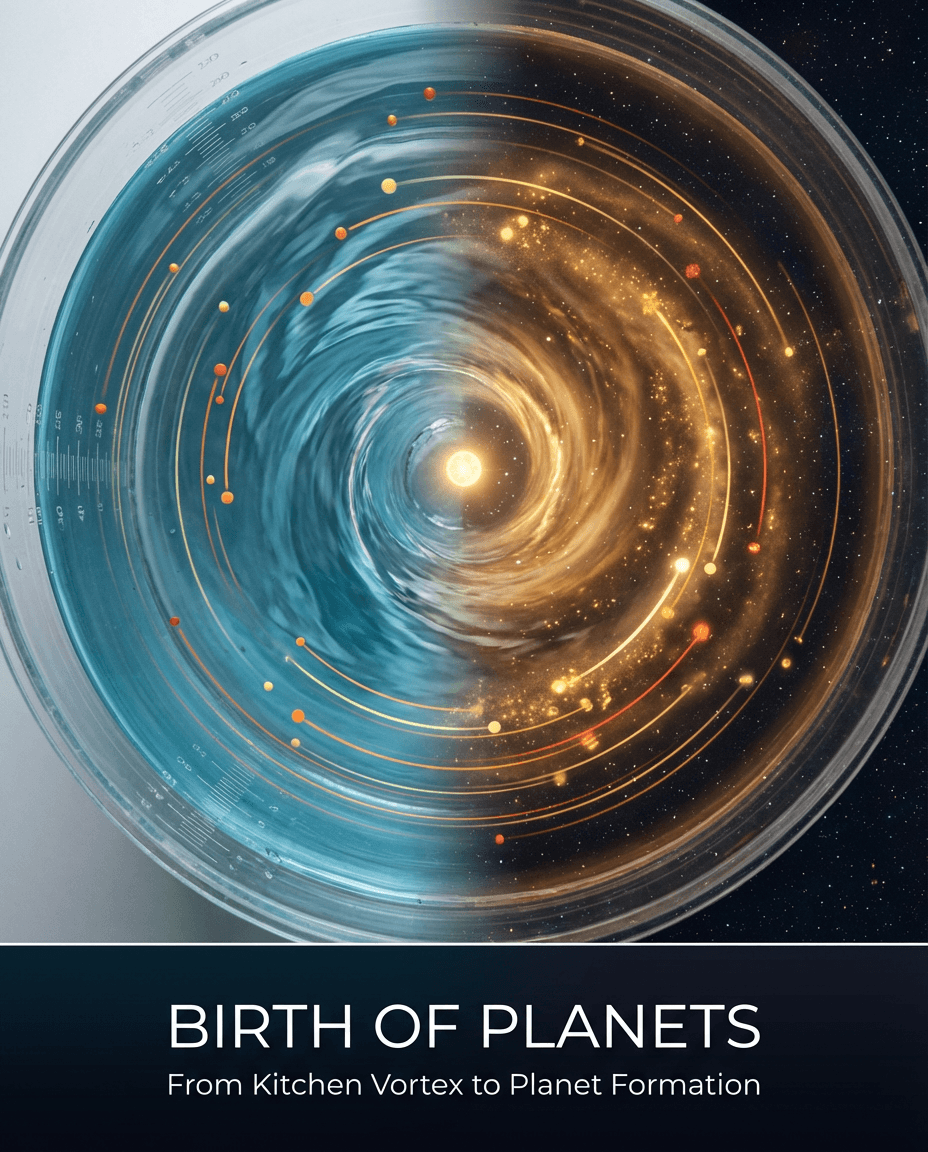
In July 2025, Max Planck Institute researchers proved a simple water vortex can model how material flows in protoplanetary disks - cosmic nurseries where planets are born.
The Open Question They Left Behind
Their team used uniform plastic beads. But real cosmic dust varies wildly: fluffy aggregates, compact spheres, flat flakes. How does particle shape and density affect the rate of spiral infall toward a young star?
Why This Matters
The "meter-size barrier" is one of the biggest unsolved puzzles in planet formation science. Dust must clump into kilometer-scale planetesimals, but particles of certain sizes drift inward too fast to grow. Understanding how shape affects drift could unlock new answers.
Your Research Direction
- Do flat particles spiral differently than spheres?
- How does buoyancy change orbital decay?
- What path shapes emerge for irregular particles?
- Does Kepler's 3rd Law hold across particle types?
A kitchen vortex becomes a window into how worlds are born.
Reference: DOI: 10.1093/mnrasl/slaf070