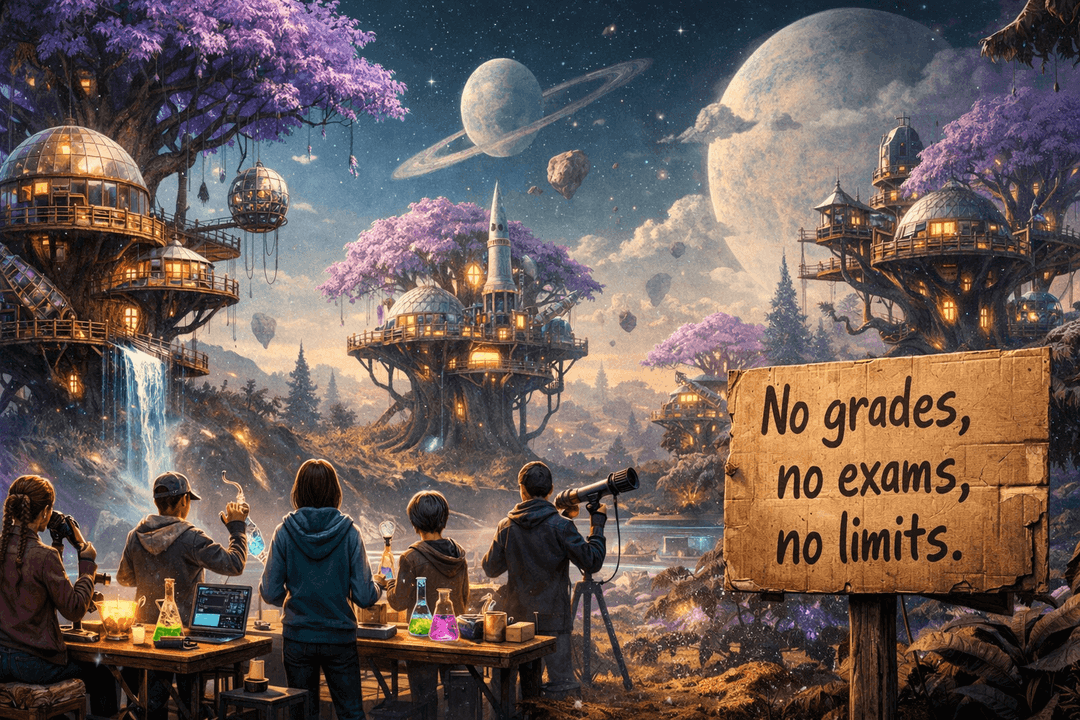
We didn't set out to critique a civilization, we just wanted somewhere to make messy experiments without being lectured about protocols. On the main worlds, adults with titles like "Arch-Archivist" insisted all the mysteries were catalogued. Kids were taught to repeat equations like hymns. If you asked whether the equations could change, you were told to focus on "application exercises."
Peter was one of the few who didn't buy it. He'd pitched teen-led research programs to the planetary academies and been patted on the head. On a walk home, he looked up at the gas giant our system's third planet orbited and wondered aloud why curiosity was treated like a biological clock. At the next Council meeting he dared them to prove discovery was really over by handing an unused planet to teenagers. They rolled their eyes and gave him Vesper, a moss-green world with light gravity and no strategic mineral deposits.
Peter didn't recruit from elite prep domes. He sent encrypted messages through gaming forums: "Want to build impossible things and not get detention? Meet me on Vesper." That's where I found him.
I'm Aria - self-taught in orbital mechanics via modding strategy games. Along with me came Luca (who turns junk into antennae), Mina (who sketches fractals like they're portraits), Samir (who writes code like haiku) and Daniel (who can explain thermodynamics faster than you can blink).
We called our collection of treehouses and labs an Institute and hung up a cardboard sign: No grades, no exams, no limits. Mondays were "What if?" days, and Peter grilled us harder than any proctor. "Why would the universe care about your assumption?" he'd ask. We groaned and then thought.
The Science That Sparked Trouble
The science that sparked trouble began over noodles. I complained that observing storms on the gas giant would be easier if our atmosphere wasn't such a chaos goblin.
Earth-like telescopes have to fight turbulence - hot and cold pockets of air bend light, making vortices blur. Peter sketched how adaptive optics usually solves this with expensive lenslet arrays and deformable mirrors. Samir twirled a chopstick and suggested skipping the fancy sensors entirely: what if we just shone a laser through a controlled plume of hot air and read the wiggles of the dot on a camera? Mina - who reads lidar papers for fun - grinned. A laser spot's jitter (physicists call it angle-of-arrival fluctuation) tells you how chaotic the air was. If we inverted that dance, we could build a cheap testbed.
Our setup looked like something out of a sci-fi sitcom: a glass box scavenged from a greenhouse, a toaster coil for heat, a repurposed laser pointer and a camera Samir hacked to track jitter.
The first attempt fried the webcam and blew a fuse. Someone spilled ramen on the code. But by the end of the week, we had algorithms that could find a jittery green dot in a blizzard. Turn the coil off and the spot barely moved; turn it on and it jittered like it had downed two liters of soda. Samir wrote scripts to translate those wiggles into graphs. Mina tweaked algorithms to invert them.
We called the project Mirage because what's cooler than building an illusion that teaches you physics? We spent nights lit by lasers and code, laughing when the plume knocked over our assumptions.
The Betrayal
Zander was one of the first adults to visit Vesper. He pretended to mentor us but kept glancing back toward the Ark - the massive archive on the adults' planets where every peer-reviewed fact is filed. He whispered to Peter about respectability and proper journals. When a few benefactors caught wind of "cheap adaptive optics," Zander's jealousy took shape. He pulled Daniel aside.
Daniel - ambitious enough to want his name on a discovery more than lunch - listened when Zander suggested moving to Osiris, one of the adults' worlds. "No vines," he promised. "No chaos. Real labs."
They packed copies of our schematics and left in the next shuttle. While we debugged code that mistook window drafts for comet eruptions, Zander and Daniel set up a "library lab" in an unused wing of the Ark. Donors sent them credits. Without our obsession over airflow, their plumes were wild columns of heat. Without Mina's knack for pattern recognition, their code turned noise into nonsense.
When Zander pitched their contraption to senior astronomers, the elders smiled and told donors you couldn't do serious turbulence inversion without an expensive kit. The credits vanished. It turned out that being on an adult planet with proper desks didn't make your hypothesis true.
Coming Home
They came back a cycle later, smelling of regret and soy latte. "We were wrong," Zander said, staring at our cardboard sign. "I thought freedom meant doing it on my own. Turns out it means listening to people who still think anything is possible." Daniel shoved a box of notebooks onto a bench. Peter handed them both goggles and said, "Grab a soldering iron."
When we reunited, something clicked. We bartered for a modern lenslet array, added a deformable mirror and trained a neural network to invert the dot dance faster. A visiting astronomer almost choked on his coffee. Soon community observatories on different worlds were using our plans to watch exoplanet transits without mortgaging their domes.
The Crack in the Myth
The institute expanded like a network of treehouses. New teens arrived with wild ideas about bacterial computers and compostable surfboards. We kept vines and string lights. People built hydroponic gardens next to circuit boards. Zander became our loudest spokesperson. He would stand in front of conferences and tell anyone who would listen that he once thought you couldn't trust teenagers with science. Then he would show them what happens when you do.
Vesper didn't fix the adult system overnight. On planets like Osiris, kids still memorize facts like prayers. Council members still grumble that we wasted a perfectly good world on unsupervised adolescents. But a crack opened in the myth that curiosity expires at twenty.
When I visit one of the adults' worlds and see middle-schoolers hiding a wind tunnel in a storage closet, I catch Peter's eye across the plaza and smile. Good ideas don't retire. They hop between worlds, dance in thin air and wait for someone reckless enough to decode them.
Florence Cole
Science Fiction author