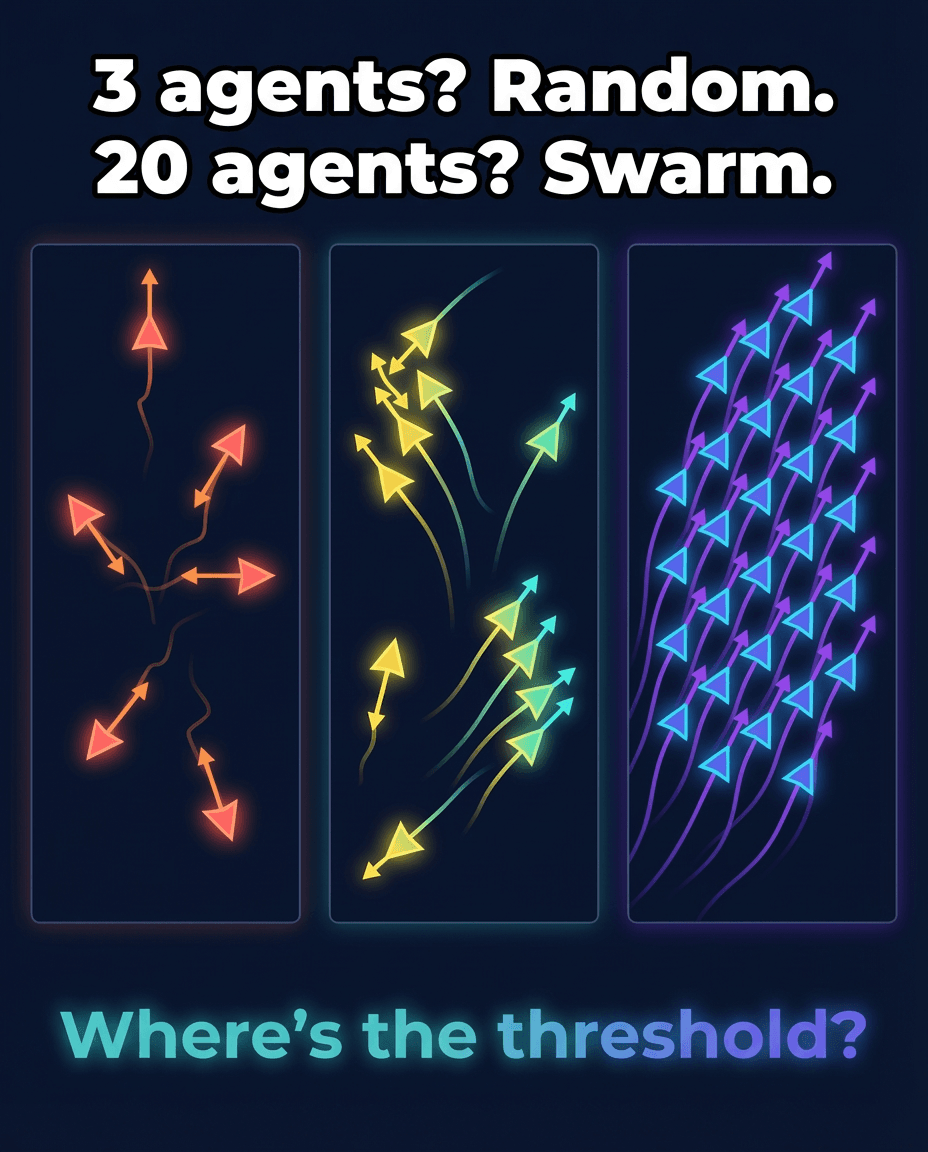
Individual agents, whether robots, birds, or simulated particles, follow simple local rules: align with neighbors, stay together, avoid collisions. No leader. No master plan. Yet at some critical size, scattered individuals become a unified collective.
The Physics of Emergence
Large flocks spontaneously organize into coordinated motion. The physics of big swarms is well-mapped. But between 3-20 agents lies a transitional regime where collective behavior is born. Does it emerge gradually or in discrete jumps? Is there a magic number where 4 agents behave collectively but 3 do not? How does fragility change with size?
The Challenge
You can explore this through computational simulations, varying agent count from 3 to 20, hunting for thresholds and unexpected transitions. Map how phase diagrams shift with minimal groups. Test whether tiny swarms follow the same rules as large ones. This is territory where patterns wait to be discovered.
Why It Matters
Understanding where "individual" becomes "we" illuminates fundamental physics of emergence. Small robot teams and cellular clusters operate in exactly this regime.
Tools needed: Wolfram Mathematica • NetLogo • Python