TL;DR
- PSSC began at MIT in 1956, before Sputnik, to replace fact collecting with physics as an experimental, connected way of reasoning.
- It built a whole teaching system: textbook, laboratory guide, teacher guide, tests, films, readings, equipment, and substantial teacher training.
- PSSC reached national scale, yet the course was still too long, hard to fit into a school year, and demanding to teach well.
- One of PSSC's own architects later argued that independent one-year science courses were the wrong container. Deep understanding needs a sequence, not a sprint.
In 1952, Jerrold Zacharias and two colleagues produced what MIT called the first practical atomic clock. Four years later, Zacharias turned to a problem that looked smaller: the way American teenagers learned physics.
That problem turned out to be large enough for a national project.
In December 1956, about 50 scientists and educators met at MIT. They did not begin by rearranging a list of textbook chapters. They asked what a student should understand about science itself: that observations reveal regularities, that regularities become laws, that laws make predictions, that every law has limits, and that models help physicists think.
The group became the Physical Science Study Committee, or PSSC. Its name was forgettable. Its ambition was anything but.
What was wrong with the old physics course?
Uri Haber-Schaim, who joined PSSC in 1957 and later became one of its principal authors, described the typical mid-1950s course as a crowded survey. It offered facts and formulas, but too little sense of how physicists arrived at them or how the ideas fit together.
That architecture mattered more than any individual topic. Covering less ground was not the goal. It was the price of giving students enough time to understand what the ground meant.
What did PSSC build besides a textbook?
Curriculum reform often means publishing a new textbook and hoping teachers can do the rest. PSSC treated the course as an interlocking system.
Testing began in eight pilot schools in the fall of 1957. Teachers from those schools had already worked with the developers that summer, and their classroom feedback led to major changes. A plan to make films the backbone of the course was abandoned when production proved too slow and film proved ill-suited to that role. A plan for students to build all their own apparatus also changed after pilots showed that construction could consume the physics lesson.
By the first commercial edition in 1960, PSSC included a textbook, laboratory guide, extensive teacher guide, achievement tests, films, short science books, and specially designed laboratory equipment. Different ideas could arrive through a reading, an experiment, a film, or a teacher's demonstration.
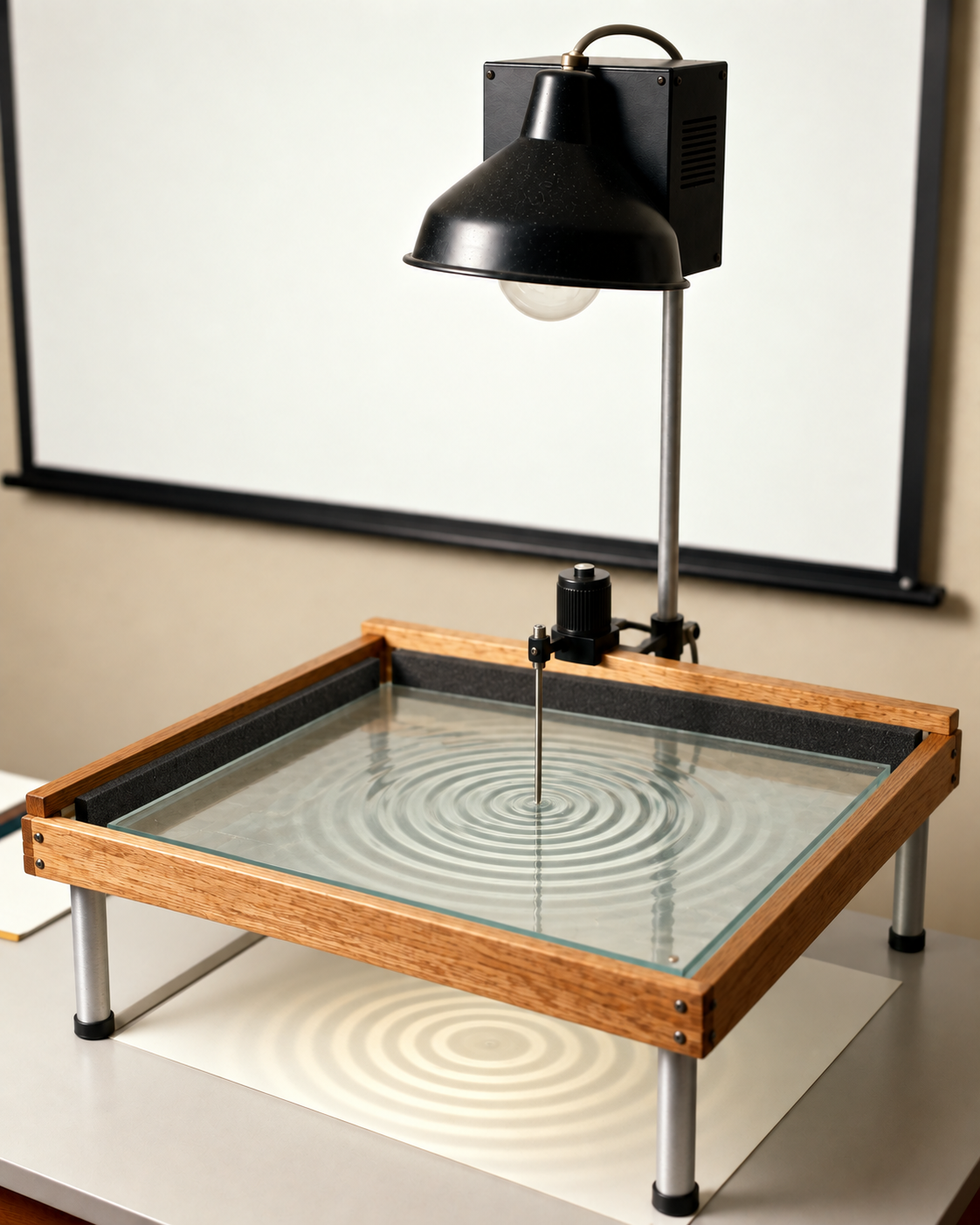
The laboratory was the center of the change. Students were not supposed to follow a recipe, fill blank tables, and confirm a result they already knew. The class was supposed to question nature and look for regularities in what happened. A ripple tank, for example, made wave behavior visible before the formal description arrived.
The films extended the same idea. Some showed experiments that a school could not perform; others put working physicists in front of students.
If you want to feel what the course was like, watch Frames of Reference (1960). The University of Toronto archive records that by 1960, PSSC had commissioned physicists Patterson Hume and Donald Ivey to make four films, including Frames of Reference. There is no swelling music or manufactured spectacle. There are two physicists, a rotating room, and a genuinely hard question about what motion means, taken completely seriously. Its upside-down scenes and floating objects still work because the camera itself becomes part of the physics.
This was not hands-on work as decoration. Observation, representation, and explanation were meant to reinforce one another.
How far did it spread?
Sputnik is often placed at the start of this story, but the chronology is important. PSSC was already under way before the Soviet satellite launched in October 1957. Sputnik changed the political climate and helped federal funding for teacher training and equipment expand, but it did not invent the project.
Adoption remained voluntary. Teacher preparation was therefore essential. Five summer institutes began in 1958, followed by more summer, academic-year, evening, and Saturday programs. Haber-Schaim was blunt about why: even a detailed teacher guide could not create the practical judgment needed to run an investigative laboratory. The NSF funded most of those programs.
The system grew quickly. An MIT release from 1963 reported that approximately 135,000 students were taking PSSC, around 30 percent of everyone then enrolled in high school physics in the United States. It also recorded that 53 PSSC films had been produced. The textbook eventually passed its millionth copy.
Those numbers make the usual ending, "an interesting course that never caught on," impossible. PSSC did catch on. The more useful question is why a course with that reach was so difficult to sustain in its original form.
Where did the course strain?
The project kept listening after publication, and the feedback exposed structural problems.
First, the course was too long. Even after traditional topics had been removed, many classes did not get beyond the beginning of its final part on electricity and atomic structure. The schedule in the teacher guide was not realistic.
Second, the opening section was harder to teach than intended. Its measurement work was meant to set the stage quickly, but teachers and students struggled to move lightly through it. A course designed around connected reasoning could not simply hurry through its foundations without consequences.
Third, the method depended on teachers who understood both the physics and the purpose of the course. Inquiry is not the absence of teaching. It requires a teacher who knows when to ask, when to demonstrate, when to let an unexpected result stand, and when to help a class turn observation into a model. The training institutes were not an optional accessory. They were part of the curriculum.
PSSC also learned that a good course could not be frozen. Its kinematics chapter was rewritten repeatedly. In a later edition, the authors changed the sequence so students met acceleration after experimenting with motion under forces. Haber-Schaim's retrospective is valuable precisely because it does not pretend the first design was perfect.
What was the most important lesson about time?
PSSC tried extending upward with advanced topics and downward with Introductory Physical Science for younger students. The advanced material could become a second year or a three- or four-semester sequence.
That experience prompted Haber-Schaim to offer a conclusion sharper than the familiar slogan about inquiry learning. He argued that defining science as a set of independent one-year courses was a peculiarly American restriction. Physics and chemistry were taught across several years elsewhere. If the United States wanted understanding instead of memorized vocabulary, he wrote, it would need structured sequences too.
This is the part worth keeping.
PSSC did not settle the pedagogy of physics forever. No curriculum could. Its developers themselves revised the order of ideas, changed equipment plans, and discovered teaching problems through use.
What PSSC demonstrated was more durable: serious school physics can be organized around evidence, models, and connected principles. But that depth requires time, prepared teachers, and a course structure able to support it.
A demanding curriculum is not automatically a good curriculum. Nor is it wrong merely because it is demanding. The real questions are whether students have the preparation to enter it, whether teachers have the support to guide it, and whether the calendar gives understanding time to form.
What remains?
PSSC's history is not a tale of a brilliant idea that simply failed. It is a better kind of inheritance: an ambitious experiment that worked at national scale, revealed the limits of its own design, and left unusually clear evidence about what the next attempt should do.
Keep the insistence that physics is reasoning from the world, not a bag of equations. Keep the connected story, the laboratory evidence, and the expectation that a student should explain why a model works and where it stops working. But give that work the time and teacher preparation it requires.
The forgotten physics course still has something to teach us. Not only about how to teach physics, but about how long understanding takes.
Time enough to understand.
Sources
Uri Haber-Schaim. PSSC: 50 Years Later. American Association of Physics Teachers, 2006.
MIT Department of Physics. MIT Physics Education History.
MIT News Office. Educational Services Incorporated grant announcement, January 1963.
MIT Research Laboratory of Electronics. A timeline of RLE history, 1996.
University of Toronto Archives. James Nairn Patterson Hume fonds, 2008.